Labels

Tuesday, 31 January 2012

Sculpting.

Started my celeb sculpt tonight. Celeb is Benedict Cumberbatch!


Process was livestreamed and a viewer layered my model on top of a photo for reference.


HAIR, WHY.


Thursday, 26 January 2012

Role info.

Games designer:

  • Responsible for communication and awareness of concept and design throughout the team. Social and clarity of communication skills are a must -- capable of expressing themselves and their ideas.
  • Does not always require a formal qualification, and experience earned from other areas in the industry is viable to meet requirements even in bigger companies. Blizzard/World of Warcraft Game Designer.
  • Involved with game throughout the entire development cycle, adjusting role and tasks as necessary.
  • Experience is favored over a formal degree/qualification.
  • Research skills valuable, and documentation of processes and ideas necessary throughout work.

 Concept artist:

  • Freedom to define the overall look/art style of the game within the specifications given by the designer.
  • Required to be able to draw in a variety of styles and with both traditional and digital mediums.
  • Formal qualifications less essential in comparison to proven artistic ability.
  • Required to take ideas as given by designers and visualize them.
  • Can work in 2D or 3D, but majority of the jobs I found specified 2D primarily.

Sunday, 8 January 2012

12 Principles of Animation -- Examples.

Anticipation:

Good -- TF2 Pyro taunt. The pyro draws back to prepare for the attack. There is a moment of stillness, and then the attack is unleashed.

Pyro Hadouken

Slow out and slow in:

Bad -- Jade Empire running. When a character in Jade Empire runs, it goes from a complete standstill to flat out without any inbetween. This looks unrealistic and awkward.

Jade Empire Running

Ghost Trick -- An example of almost everything done right.

Ghost Trick is well known for its well done animation. The following clip shows good examples of appeal, slow out and in, secondary action, straight ahead & pose to pose, anticipation, staging, exaggeration, timing and solid drawing.

Ghost Trick.

Another example:

Ghost Trick Panic Dance.

In game.

Secondary Action: The keys on the police officer and the scarf/coat on the detective.

The following clip is an example of everything in animation done wrong, and the creators should be ashamed. Solid drawing is the principle most soiled.

Gee, it sure is boring around here.

Issues:
- Animation all moves at around the same speed, giving no impression of depth, urgency or life.
- Characters change shape, volume and form inconsistantly.
- Arms and heads move awkwardly, without real knowledge of arcing or anatomy.
- No follow through. Things stop abruptly.

Wednesday, 30 November 2011

Advertising Project.

Interactive ideas:

Interactive projection.

Uses the movements of onlookers to alter the projection, allowing for an artistic and interactive performance. Face tracking/custom optical flow was used.

Saturday, 19 November 2011

Art Style Influences

I wanted the art for my game to be as simple as possible -- my own style is intensely meticulous and I overly detailed for an iPhone game. The most successful iPhone games are very streamlined and uncluttered in appearance. Therefore, I started looking at styles that were capable of representing forms with few lines and strokes.


Phoenix Wright, a well known title for the DS, uses simple shading and lighting in order to portray depth. Anime, while not my style of choice, is very good for expressing human form in an oversimplified way. Next, we go back to a game previously mentioned as an influence for its gameplay, The World Ends with You.


TWEWY is very distinctive, using thickly weighted lines and again, simple shading, to express form. The game is very consistant in its style, with each character thinly waisted and many enemies reminiscent of animals a person might find in the real world.


Above is an image from Tales of Symphonia. While in-game, models are heavily simplified and not overly detailed. While this game is not handheld, it captures the intentional movement away from realism I was trying to grasp. Below are some initial attempts and experiments, moving more toward something closer to what I wanted to achieve.


Wednesday, 9 November 2011

Tenative concept.

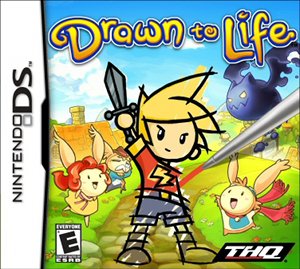
After reading through Andrew Loomis' figure drawing book this evening, inspiration struck. Drawn to Life, with its sketchy art style, always appealed to me stylistically. It showed, to a point, different stages of drawing aside from the finished product; something I find very interesting as an artist.

Drawn to Life has multiple modes:
  • Village mode: Interaction with buildings and NPCs takes place here. Displayed in top-down view, this area is the central hub for level access, item buying and story progression.
  • Adventure mode: Side-scrolling platformer mode where battles take place. Players draw their own platforms in order to cross obstacles and defeat bosses in each zone/area.
  • Draw mode: Where players design their own creations and bring them to life using the stylus/touch screen.
(Wikipedia, 2009)


Within Loomis' book, he introduces the mannikin frame on page 38, under the heading 'we begin to draw: first the mannikin frame'. The visual simpilicty of this frame was always something I found very appealing -- it enabled the artist to be able to express movement and form with very few lines.


I was keen to find a way to express this simplicity and form within the art style of my game. Eventually, the idea formed; a game wherein the player begins in the mannikin form, then advances to a more fleshed out, humanoid being as they make progress through dungeons and defeating bosses.

Concept:
  • Set in a small village that becomes the safe zone hub mentioned in a previous post.
  • Village is watched over by a guardian in the form of a tree, which is then corrupted by an invading evil.
  • As a result of the tree's corruption, the inhabitants of the village and the village itself begins to lose form and mass, becoming close to Loomis' mannikin representation of people.
  • Players must climb the floors of the tree, fighting in a hack-and-slash style through randomized dungeon floors toward bosses.
  • When a boss is defeated, the village and the player character begin to move back toward their original forms.


Tuesday, 8 November 2011

An idea.

iPhone and iPad games, in my mind, should not be too story heavy or demanding on a player's time. While the App Store does have bigger, more involving games like RPGs, the top selling and most well known games are those repeatedly described as 'simple' and 'easy to pick up'. Mobile gaming is all about convenience; games that are easy to jump in and out of are more successful because they can be played during lunches or ten minute downtimes throughout the day. A list of the most popular iPhone games can be found here.

The top ten games are visually distinctive and easy to play. While they, like most games, take practice to become very good at, the average player can pick the game up and become familiar with the controls within just a few short minutes. Thus, the controls are 'intuitive'; easy to use and understand.

Replayability in hack-and-slash games is very important, especially when they're competing against the appeal of score-grinding in a puzzle game like Angry Birds. The randomization of dungeon floor generation is a way to combat this.

An extreme example of floor randomization can be seen in the RPG Persona 3. Players are required to navigate their way through Tartarus, a tower that only appears at midnight and leads toward an unknown evil. There are 265 floors a player must fight through in Tartarus, broken up by bosses every ten or fifteen floors. The process is kept from becoming too repetative by changing the layout of each floor every time it is traversed, and by having enemies increase slowly in difficulty.


While the combat in Persona 3 is the usual turn-based mechanic you would expect from a JRPG, it manages to achieve the objective of having a player repeat the same action multiple times without it becoming repetative. Floor climbing is broken up by visits to non-combat zones and social interaction. While the latter is not suitable for the game I have in mind, this gave me the idea of using a hub as a base of operations for the player; a place for them to view their achievements (enemies defeated, longest run made) and organize the items they have acquired while taking a break from the fighting sections of the game.