Labels

Showing posts with label App Store. Show all posts

Saturday, 19 November 2011

Art Style Influences

I wanted the art for my game to be as simple as possible -- my own style is intensely meticulous and I overly detailed for an iPhone game. The most successful iPhone games are very streamlined and uncluttered in appearance. Therefore, I started looking at styles that were capable of representing forms with few lines and strokes.


Phoenix Wright, a well known title for the DS, uses simple shading and lighting in order to portray depth. Anime, while not my style of choice, is very good for expressing human form in an oversimplified way. Next, we go back to a game previously mentioned as an influence for its gameplay, The World Ends with You.


TWEWY is very distinctive, using thickly weighted lines and again, simple shading, to express form. The game is very consistant in its style, with each character thinly waisted and many enemies reminiscent of animals a person might find in the real world.


Above is an image from Tales of Symphonia. While in-game, models are heavily simplified and not overly detailed. While this game is not handheld, it captures the intentional movement away from realism I was trying to grasp. Below are some initial attempts and experiments, moving more toward something closer to what I wanted to achieve.


Wednesday, 9 November 2011

Tenative concept.

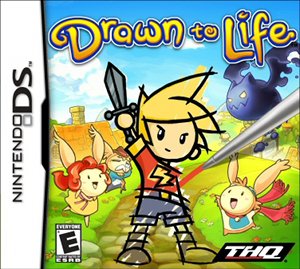
After reading through Andrew Loomis' figure drawing book this evening, inspiration struck. Drawn to Life, with its sketchy art style, always appealed to me stylistically. It showed, to a point, different stages of drawing aside from the finished product; something I find very interesting as an artist.

Drawn to Life has multiple modes:
  • Village mode: Interaction with buildings and NPCs takes place here. Displayed in top-down view, this area is the central hub for level access, item buying and story progression.
  • Adventure mode: Side-scrolling platformer mode where battles take place. Players draw their own platforms in order to cross obstacles and defeat bosses in each zone/area.
  • Draw mode: Where players design their own creations and bring them to life using the stylus/touch screen.
(Wikipedia, 2009)


Within Loomis' book, he introduces the mannikin frame on page 38, under the heading 'we begin to draw: first the mannikin frame'. The visual simpilicty of this frame was always something I found very appealing -- it enabled the artist to be able to express movement and form with very few lines.


I was keen to find a way to express this simplicity and form within the art style of my game. Eventually, the idea formed; a game wherein the player begins in the mannikin form, then advances to a more fleshed out, humanoid being as they make progress through dungeons and defeating bosses.

Concept:
  • Set in a small village that becomes the safe zone hub mentioned in a previous post.
  • Village is watched over by a guardian in the form of a tree, which is then corrupted by an invading evil.
  • As a result of the tree's corruption, the inhabitants of the village and the village itself begins to lose form and mass, becoming close to Loomis' mannikin representation of people.
  • Players must climb the floors of the tree, fighting in a hack-and-slash style through randomized dungeon floors toward bosses.
  • When a boss is defeated, the village and the player character begin to move back toward their original forms.


Tuesday, 8 November 2011

An idea.

iPhone and iPad games, in my mind, should not be too story heavy or demanding on a player's time. While the App Store does have bigger, more involving games like RPGs, the top selling and most well known games are those repeatedly described as 'simple' and 'easy to pick up'. Mobile gaming is all about convenience; games that are easy to jump in and out of are more successful because they can be played during lunches or ten minute downtimes throughout the day. A list of the most popular iPhone games can be found here.

The top ten games are visually distinctive and easy to play. While they, like most games, take practice to become very good at, the average player can pick the game up and become familiar with the controls within just a few short minutes. Thus, the controls are 'intuitive'; easy to use and understand.

Replayability in hack-and-slash games is very important, especially when they're competing against the appeal of score-grinding in a puzzle game like Angry Birds. The randomization of dungeon floor generation is a way to combat this.

An extreme example of floor randomization can be seen in the RPG Persona 3. Players are required to navigate their way through Tartarus, a tower that only appears at midnight and leads toward an unknown evil. There are 265 floors a player must fight through in Tartarus, broken up by bosses every ten or fifteen floors. The process is kept from becoming too repetative by changing the layout of each floor every time it is traversed, and by having enemies increase slowly in difficulty.


While the combat in Persona 3 is the usual turn-based mechanic you would expect from a JRPG, it manages to achieve the objective of having a player repeat the same action multiple times without it becoming repetative. Floor climbing is broken up by visits to non-combat zones and social interaction. While the latter is not suitable for the game I have in mind, this gave me the idea of using a hub as a base of operations for the player; a place for them to view their achievements (enemies defeated, longest run made) and organize the items they have acquired while taking a break from the fighting sections of the game.

Monday, 31 October 2011

Initial game research/ideas.

According to the data found at this site, games apps currently make up 16.80% of the total App Store market. The data was last updated 2011-10-31 06:00:27 -0700 PDT.

Having had no hands-on experience with an iPhone, my initial ideas looked toward successful DS games I've played for inspiration. While the two platforms are not overly similar, they both use a touch screen. One game that caught my attention was 'The World Ends with You'. The World Ends with You merges action and role-playing genres to create a hack-and-slash style battle system merged with heavy doses of JRPG story. While the latter isn't necessarily something I want to incorporate, the battle controls allow for flawless touch-based input.

To move a character, a dragging motion is used -- starting from the character and moving around the screen. Finally, to attack, a player is required to tap an enemy, or draw shapes upon the screen depending on which type of attack the player wants to use. The way the game uses the touch screen during battle is almost flawless, and something that could easily be transferred across to an iPhone/iPad format. Below are two pictures of different attack types being used within the game; the first activated by dragging across remote empty space and the second activated by tapping the target enemy from a distance.

Barbed wire is cast across the screen, where it remains for a set amount of time to damage enemies.
Attacking with bolts of lightning.

Additionally, gameplay videos where the different kinds of attacks are demonstrated can be found here and here.

With this in mind, the sort of game I want to create will merge hack-and-slash controls with a roguelike inspired dungeon replayability. One recent and successful 'roguelike'-esque game that captures the simplicity I wish to aim for is The Binding of Isaac; featured on the PC.

The Binding of Isaac follows a boy's journey through the dungeon-like basement of his house. Rooms are randomly generated, allowing for huge amounts of replayability. The game isn't heavily story focused aside from an introduction to set the scene, and much of the game's appeal are the many, many items a player can retrieve in order to improve their offensive and defensive capabilities. Each item modifies the player avatar, often with amusing results visually.

As well as rooms being randomly generated, entire dungeon 'floors' are also made at random. Each floor contains a boss which must be defeated in order to move to the next floor. At the end of the chain of floors, the player must face Isaac's Mother, who is attempting to sacrifice him in order to prove her faith to 'God'.

In contrast to The World Ends with You, which allows multiple attack methods, the main way to attack in The Binding of Isaac is ranged. The player is able to shoot Isaac's 'tears' at enemies. While there are special weapons that occasionally allow for other methods of attack (such as one that turns you into an invincible boy with a unicorn horn), the main method remains very much the same throughout the game. Strategic use of bombs is also a valid tactic.

The game mixes a very simplistic artstyle with often disturbing concepts (travelling through Mom's womb to attack her heart) and themes in order to create a distinctive and memorable visual style. The Binding of Isaac is very much a pick up and play game -- permadeath is used and runs are often cut very short by a spree of bad luck. This is a very suitable gameplay style for an iPhone or iPad game, as many of the games on these platforms are timewasters during periods of downtime. There are no save functions; items gathered and items unlocked are saved automatically upon game end/death. The only thing retained between runs is information on the items a player has unlocked and is able to obtain on their next run.
Randomly generated room. From left to right: Map, coins bombs and keys remaining, arrows, special item and health remaining.

The Binding of Isaac boss battle.
 
Another interesting little feature of the game is the inclusion of items such as 'Brother Bobby' and 'Sister Maggie'. These are items that can be picked up in much the same way as any other, but float beside your shoulder and attack with you. These are 'familiars' and are able to attack, defend and perform other tasks for the player. 

Sister Maggie

As I do within many games, I felt a little comforted by the presence of a 'helper' I could use to go through the dungeon.

This brought me to a game I'm playing currently; Rune Factory. A spin-off from the long-standing Harvest Moon series, Rune Factory combines the farming and social bonding aspect of HM with dungeon crawling. However, as an extension of farming, the player character is capable of taming creatures found within the dungeons they traverse. These creatures are capable of picking their own target and different creatures have signature attack styles and skills.


These monster companions are not necessary or gamebreaking; they are useful assistants but will not make or break the tide of a battle.

My initial game parameters so far would be:
  • Hack-and-slash real time combat through touch screen attack input.
  • Dungeon crawling replayability through randomized rooms and floors.
  • Stat increasing items.
  • Optional companion system.
  • Simplistic but distinct art style.

Friday, 28 October 2011

New project, new labels!

With the majority of the work on the board game project out of the way (bar some document compiling), we've received the second brief. I am to design a game for Apple's App Store. Having never so much as held an iPhone, iPod or iPad, my research started at the very beginning; examining the technical specifications of the devices.

All of the devices mentioned feature multi-touch technology, allowing for 'multi gestures'.
  • One finger touch:
    • Generally used to move objects from one place to another, via dragging. One finger touches are also used to tap objects, like a button or an app.
  • Two finger touch:
    • Also called a 'pinch' and most comfortably done with the thumb and finger. This is done to zoom in on images. Reversing the pinch enlarges an image.
  • Three/four finger touch:
    • Mostly used on Macbooks, three finger swipes allow navigation back and forth between webpages. A four finger swipe activates Expose (application switch menu) or shows the desktop, depending on which way the fingers are swiped.

iPhone - iPhone 4 Specifications:

Display and resolution: 
  • 88m (3.5in) glass LCD, 3:2 aspect ratio.
  • 480 x 320 px (HVGA) at 163 ppi.
    • 960 x 640 px at 326 ppi from the iPhone 4 and onward.
Storage:
  • 4, 8 or 16 GB on the original iPhone.
    • 8 or 16 GB on the iPhone 3G.
    • 8, 16 or 32 GB on the iPhone 3GS or iPhone 4.
    • 16, 32 or 64 GB on the iPhone 4S.
CPU Core:
Apple iPhones utilize underclocking of more poweful CPUs to preserve battery life. It was found that slower processors caused worse battery performance than a more powerful, but underclocked, processor.
  • 620 MHz (underclocked to 412 MHz) ARM 1176JZ(F)-S in the iPhone and iPhone 3G.
  • 833 MHz (underclocked to 600 MHz) ARM Cortex-A8 used in the iPhone 3GS.
  • 1 GHz (underclocked to 800 MHz) Apple A4 used in the iPhone 4.
  • 1 GHz (underclocked to 800 MHz) Dual-core Apple A5 used in the iPhone 4S.
Memory:
  • 128 MB DRAM in the iPhone and iPhone 3G.
  • 256 MB DRAM in the iPhone 3GS.
  • 512 MB DRAM in the iPhone 4 and iPhone 4S.
Features:
  • USB 2.0/dock connector.
  • Assisted GPS, including earphones with mic (added with the iPhone 3G).
  • Voice control, digital compass, Nike+ camera tap to focus. Includes earphones with remote and microphone (added with the iPhone 3GS).
  • 3-axis gyroscope, dual-microphone, noise suppression, microsim, rear-camera LED flash (added with the iPhone 4).
  • Siri (beta) voice assistant and GLONASS support (added with the iPhone 4S).
All later iPhones retained the features from previous iPhones as well as their newly added additional features.

Camera:
  • 2.0 Megapixel, f/2.8. Still images only. iPhone and iPhone 3G.
  • 3.0 Megapixel, f/2.8 VGA video at 30 frame/s. Added with the iPhone 3GS.
  • Rear 5.0 Megapixel, f/2.8. 720p HD video at 30 frame/s. Added with the iPhone 4.
  • Rear 8.0 Megapixel, f/2.4. 1080p Full HD video at 30 frame/s. Added with the iPhone 4S.
    • Both iPhone 4 and iPhone 4s have a 0.3 Megapixel (VGA) 480P video at 30 frame/s.
Power:
  • All iPhone models use a built in, nmon removable, rechargable lithium-ion polymer battery (LiPo).

iPad/iPad 2:

Display and resolution:
  • 9.7 inches (25cm) multitouch display. 1024 x 768 pixels with LED backlighting and a fingerprint/scratch-resistant coating. 
Processor:
  • 1 GHz Apple A4 system-on-a-chip. Used in the iPad.
  • 1 GHz (dynamically clocked) dual-core Apple A5 system on a chip. Used in the iPad 2.
Memory: 
  • 256 MB DDR RAM built into Apple A4 package. Used in the iPad.
  • 512 MB DDR2 (1066 Mbit/s data rate) RAM built into Apple A5 package. Used in the iPad 2.
Storage:
  • 16, 32 or 64 GB.
Environmental Sensors:
  • Accelerometer, ambient light sensor, magnetometer.
    • Gyroscope added in iPad2.
Camera:
  • 720p HD still and video camera 0.7 MP, 30fps still camera, 0.3 MP. iPad 2 only.


iPads and iPhones as gaming devices:

Two of the clearest advantages the iPad has over the iPhone are the screen size and resolution. The iPhone 4S, being the latest iPhone model, has a resolution of 960 x 640 px at a ratio of 3:2. The iPad, however, sits at 1024 x 768 in a 4:3 ratio. Physically, the iPad is much larger; 9.7 inches vs the iPhone's 3.5 inches. The iPad's build also renders it faster than the iPhone 4, allowing for the development of more advanced and taxing apps.

However, apps designed for the iPhone can be played on the iPad, while iPad exclusive apps cannot be played on the iPhone.

The features of the iPhone and iPad are actually well suited to gaming. The multi-touch screen in particular is very responsive to different kinds of touches; in a hack and slash game a single finger drag could move the character, while a tap on an enemy could be used to indicate a sword slash.